Valley Real Estate News & Updates

You’ll find our blog to be a wealth of information, covering everything from local market statistics and home values to community happenings. That’s because we care about the community and want to help you find your place in it. Please reach out if you have any questions at all. We’d love to talk with you!

Aug. 6, 2026

Planning Your Arizona Retirement or Second Home: Where to Begin

For many people, the idea of owning a home in Arizona doesn't begin with an immediate move. It begins with a vision.

Maybe you're dreaming of escaping cold winters, spending more time outdoors, living closer to family, or creating a place where future vacations eventually become everyday life. Others are beginning to think about retirement and wondering what the next chapter could look like.

Whatever your timeline, one thing is true: you don't have to be ready to move to start planning.

Why Arizona Continues to Attract Retirees and Second-Home Buyers

Arizona has long been one of the country's most popular destinations for retirees and seasonal homeowners - and it's easy to see why.

With abundant sunshine, mild winters, world-class golf, hiking, beautiful desert scenery, and a wide variety of communities, Arizona offers something for almost every lifestyle. Whether you're looking for a lock-and-leave condo, an active adult community, a golf course home, or a neighborhood where the grandkids can visit comfortably, there are plenty of options to explore.

Many buyers begin researching years before they're ready to purchase. That extra planning time often leads to better decisions because it allows you to become familiar with different communities, understand the costs of ownership, and recognize opportunities when the right home becomes available.

Retirement Starts with a Plan, Not a Timeline

You don't need a retirement date on the calendar to start planning. In fact, many people begin exploring Arizona years before they make the move so they can better understand the communities, housing options, and lifestyle that best fits their goals.

Whether you're considering a second home now or a full-time move later, asking the right questions early can help you make confident decisions when the time is right.

Some of the questions I help future Arizona homeowners answer include:

  • Which communities best fit your lifestyle and budget?
  • Is an active adult community or a traditional neighborhood the better fit?
  • Would a lock-and-leave home make seasonal living easier?
  • What should you expect for property taxes, HOA fees, and ongoing ownership costs?
  • Which areas offer convenient access to healthcare, golf, hiking, airports, shopping, or family?
  • How should the sale of your current home be coordinated with your move to Arizona?

It's also natural to wonder whether today's market is the "right" time to buy. With changing interest rates, shifting home prices, and constant headlines, it's easy to feel uncertain.

The truth is, most successful retirees and second-home buyers aren't trying to perfectly time the market (spoiler alert: it’s nearly impossible to do!), they're focused on finding the home and lifestyle that's right for them. Having a clear understanding of your budget, priorities, and long-term goals allows you to move forward with confidence, regardless of what the latest headlines say.

The market will always change, but a thoughtful plan gives you the flexibility to adapt and make decisions based on your goals, not market speculation.

You Don't Have to Have Everything Figured Out

Whether you're thinking about purchasing a second home, planning for retirement in a few years, or simply wondering what's possible, you don't need to have all the answers before reaching out.

Sometimes the most valuable step is simply learning about the options available so you can make informed decisions when the time is right.

If Arizona is part of your future, I'd be happy to help you explore communities, discuss what you're looking for, answer your questions, and provide homes that fit your vision and budget without any pressure or obligation.

The best retirement and second-home plans don't begin with perfect timing. They begin with a conversation.

If you're ready to start exploring or just have a few questions - I'd love to help! Reach out to me directly anytime at 480-529-5893, or amy@brooksrealestategroup.com.

Posted in Home Buying Tips
July 21, 2026

What Arizona Buyers Are Negotiating Right Now—And What the Latest Market Data Tells Us

If you've been following the headlines, you've probably heard a mix of conflicting messages about the housing market. Some suggest buyers should wait, while others warn prices will continue climbing.

The reality is more nuanced.

Arizona's housing market has become more balanced, creating opportunities for buyers who understand how to negotiate—and for sellers who price their homes strategically.

The Numbers Tell an Interesting StoryJuly Market At-A-Glance

Here's what happened across the Valley in July 2026:

  • 24,131 active listings, down 3% from a year ago
  • 7,742 homes under contract, up 3%
  • 6,587 closed sales, up 6.2%
  • Median sales price of $451,000, up 7.1%
  • Median days on market: 48 days, five days longer than last year

At first glance, these statistics may seem contradictory. Homes are taking slightly longer to sell, yet prices continue to rise and more buyers are entering the market.

In reality, that's exactly what a healthier market looks like.

Instead of the frantic pace we experienced a few years ago, today's market gives buyers more time to evaluate their options while still supporting steady home values.

Buyers Have More Negotiating Power Than Many People Realize

One of the biggest misconceptions today is that buyers have little leverage.

In many Arizona neighborhoods, the opposite is true.

Depending on the property, buyers are successfully negotiating:

  • Price reductions on homes that have been on the market longer
  • Seller-paid closing costs
  • Temporary or permanent mortgage rate buy-downs
  • Repair requests and inspection credits

Those concessions can significantly reduce a buyer's upfront costs and monthly payment. Two homes with similar list prices can result in very different long-term costs simply because one purchase was negotiated more effectively.

Risk Isn't About Timing the Market

Many prospective buyers worry about purchasing at the "wrong" time.

But in my experience, the biggest risk isn't market timing—it's making a purchase without a strategy.

Today's buyers are reducing risk by:

  • Focusing on neighborhoods with strong long-term fundamentals
  • Negotiating seller concessions whenever possible
  • Using mortgage rate buy-downs to lower monthly payments
  • Avoiding emotional bidding situations
  • Purchasing homes that align with their long-term financial goals

Successful buyers aren't trying to predict the next market cycle. They're making informed decisions based on today's opportunities.

What This Means for Sellers

While buyers have more room to negotiate, this isn't a weak market for sellers.

Inventory remains relatively tight compared to historical norms, homes continue to appreciate, and contract activity is increasing. Sellers who price competitively and present their homes well are still attracting qualified buyers.

Today's market rewards preparation more than urgency.

The Bottom Line

Arizona's housing market isn't as simple as "buyer's market" or "seller's market."

It's a market where preparation, pricing, and negotiation matter more than ever.

For buyers, that means there are real opportunities to reduce costs through thoughtful negotiation.

For sellers, it means realistic pricing and strong presentation continue to produce successful outcomes.


Whether you're buying, selling, or simply watching the market, understanding what's happening beyond the headlines leads to better decisions.

Aug. 26, 2025

As Inventory Rises, Home Buyers Are Seeing Opportunity

Reposted from NAR Magazine

As Inventory Rises, Home Buyers Are Seeing OpportunityHome purchasers may find they have their best negotiating power in more than five years. More homes are finally hitting the market—and buyers are taking notice. Existing-home sales rose 2% in July from the previous month and inched above last year’s pace, as home buyers respond to the largest inventory of homes for sale in years, the National Association of REALTORS® reported Thursday. Existing-home sales reflect completed transactions for single-family homes, townhomes, condos and co-ops.

“Home buyers are in the best position in more than five years to find the right home and negotiate for a better price,” says Lawrence Yun, NAR’s chief economist. “Current inventory is at its highest since May 2020, during the COVID lockdown.” The number of For Sale signs is up nationally by about 16% over last year’s levels.

Home prices are moderating, too. The median existing-home price was $422,400 in July, representing just a 0.2% increase from a year ago, NAR reports. Month-to-month, home price increases are occurring at a noticeably slower pace.

That “ever-so-slight improvement in housing affordability is inching up home sales,” Yun says. “Wage growth is now comfortably outpacing home price growth, and buyers have more choices.”

Some Markets See Price Adjustments, But Sellers Still Faring Well

More listings and stiffer seller competition may be starting to rein in home price growth in many markets. The essentially flat annual home price growth suggests that about half of the country is experiencing price reductions, Yun says.

But home sellers shouldn’t fret: Most are still faring well financially, and no major market declines appear on the horizon, Yun says. In July, foreclosures and short sales made up just 2% of transactions, remaining near historic lows.

Further, “the market’s health is supported by a cumulative 49% home price appreciation for a typical American homeowner from pre-COVID July 2019 to July this year,” Yun says. Over the last five years, the average homeowner’s wealth has increased by $140,900, NAR’s research shows.

For buyers, however, the mix of rising inventory and slower price growth may offer more negotiating power than they’ve had in years. Home builders also are making deeper concessions: In August, 37% of builders reported lowering their prices—the highest share since 2022—with average price cuts of about 5%, according to the National Association of Home Builders. Two-thirds of builders said they’re offering incentives—such as mortgage rate buydowns or closing cost assistance—which marks the highest use of sales incentives in at least five years.

Buyers are responding to the discounts in some markets. Condominium sales, for instance, increased in July in the South—a region where prices have fallen over the past year, Yun notes.

Also, mortgage applications—a gauge of future homebuying activity—remain well-above last year’s levels. Purchase applications were up 23% from the same week a year ago, the Mortgage Bankers Association reported Wednesday. That suggests more prospective buyers are preparing to enter the market.

But Don’t Discount the Competition

While the market may be opening up with more choices, buyers still can face plenty of competition. In July, 21% of homes sold above the asking price, and the average listing drew 2.1 offers, according to the latest REALTOR® Confidence Index, which reflects responses from 1,500 real estate professionals about their most recent transactions. Fifty-eight percent of real estate pros also reported that properties sold in less than one month.

Competition from all-cash buyers also remains strong. Cash transactions comprised 31% of existing-home sales in July, remaining at historical highs, NAR reports. This growing segment of buyers bypassed the elevated mortgage rates that have been blamed for sidelining many would-be buyers during the spring and summer months. First-time buyers, for example, accounted for 29% of July’s existing-home sales, well below their typical 40% share.

Regional Breakdown 

Here’s a closer look at how existing-home sales fared in July across the country, according to NAR’s latest report: 

  • Northeast: Sales rose 8.7% in July, reaching an annual rate of 500,000. Existing-home sales are up 2% annually. Median price: $509,300, up 0.8% from a year ago.
  • Midwest: Sales fell 1.1% in July, the only region to post a monthly decline last month. Yet, sales were still up 1.1% annually at an annual rate of 940,000. Median price: $333,800, up 3.9% from a year ago.
  • South: Sales rose 2.2% in July compared to June to an annual rate of 1.85 million. Sales are also up by 2.2% year-over-year. Median price: $367,400, down 0.6% from a year earlier.
  • West: Sales increased 1.4% in July to an annual rate of 720,000. But sales were down 4% compared to a year ago. Median price: $620,700, down 1.4% from July 2024.


May 20, 2025

Allow Me To De-Influence You: Homebuyer Edition

There are a lot of headlines out there about the state of the real estate market. It’s important to know what’s real, and what is simply just click bait. Here are just a few talking points to be aware of.
“A housing crash is coming”

While prices may fluctuate with interest rates, a significant crash like the one in 2008 isn’t expected. Today’s market is built on much stronger lending standards and real demand.

“A recession = housing crisis”

Historically, home values have remained steady — or even increased — during most recessions.

“You need perfect credit and 20% down”

Many buyers get into a home with far less than 20% down, and there are loan options for a wide range of credit scores. You don’t need to be perfect — just prepared.

“Mortgage insurance is something to fear”

It’s not the enemy. It’s a tool that helps buyers purchase sooner and start building equity, rather than waiting (and renting) for years.

Posted in Home Buying Tips
April 25, 2025

Townhomes: A Smart Solution for Today’s First-Time Buyers

Reposted from Keeping Current Matters

Buying your first home in today’s market can feel tough. Between high home prices and mortgage rates, affordability is still a big challenge. And some buyers are making one simple trade-off that’s getting them in the door faster: square footage.

According to the National Association of Home Builders (NAHB), 35% of buyers are willing to purchase something smaller to make homeownership happen. And one place you can usually find a smaller footprint (and sometimes better affordability) is in townhomes.

Why Townhomes Are Gaining Popularity

Townhomes typically cost less than single-family homes due to their more limited size. And that’s a big plus for today’s budget-conscious buyer. As Realtor.com says, "In today’s market, affordability remains a key priority for homebuyers, making townhomes an attractive option because they are often priced more reasonably than single-family homes. It makes them especially appealing to first-time homebuyers on a tighter budget..."

So, if you’re trying to buy but feeling stuck because of rising prices, shifting your focus to townhomes could be one way to get into homeownership without maxing out your budget.

Builders Are Responding to the Demand

Builders have seen buyers’ appetite shift to smaller homes, and they’re adjusting to meet the demand. As Joel Berner, Senior Economist at Realtor.com, explains "Builders are making a concerted effort to provide smaller, more affordable inventory to the market in a way that the existing-home market cannot. Townhomes are a significant portion of that effort."

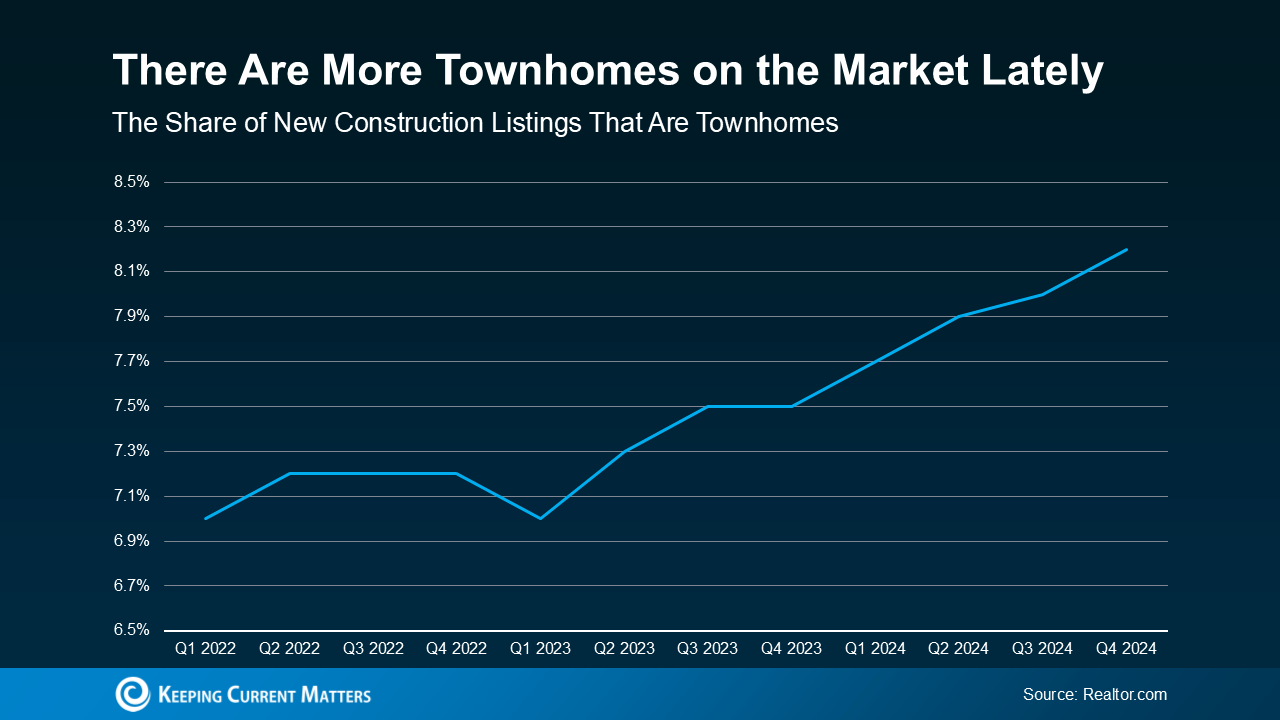
And the numbers back it up. According to data from Realtor.com, townhomes now make up a bigger share of new construction listings than they did just a couple of years ago.

That means, if you’re interested in this type of house, you have more choices than you would have had over the last few years. And more options that are potentially more affordable are definitely a good thing. It should make your search for your first home a bit easier.

Is a Townhome Right For You

If you’ve been focused only on more traditional homes with their own yards, an agent can help you explore whether a townhome could work for you. Who knows, you may find out you love the lifestyle. A lot of people do. As an article from the National Association of Realtors (NAR) explains "Townhomes tend to cost less than single-family detached homes and can be appealing to young professionals who may desire medium-density, walkable neighborhoods.”

That’s because they’re lower maintenance, they can provide a sense of community with other residents, and they have their own unique amenities. Not to mention, they give you the chance to start building wealth through homeownership without the upkeep that comes with having your own detached, single-family home. And that can be great for first-time buyers who are a bit worried about the maintenance anyway.

But they also come with some other considerations, like dealing with noise through shared walls. If you’re a renter right now, maybe you’re used to that already. But these are the types of things you’ll want to think about. And that’s where an agent’s expertise comes in. They’ll help you weigh the pros and cons, so you understand how a townhome fits into your lifestyle and long-term goals before making your decision.

Bottom Line

If you're struggling to find a home within your budget, it may be time to expand your search and consider options you haven’t before, like townhomes. Sometimes, compromising a little bit on space is worth it to get your foot in the door.


April 22, 2025

3 Reasons Why Some Homes Are Sitting On The Market Longer

Hone For SaleIn a buyer’s market, just putting a sign in the yard isn’t enough. Here’s some common mistakes sellers are making in today’s challenging market...

1. Sellers expecting “unicorn” pricing

Some sellers are still hoping for the post-COVID “unicorn” prices. But buyers today? They’re more price-conscious, especially with higher interest rates, and overpricing can lead to longer days on the market and, ultimately, a lower final sale price.

2. Sellers are skipping the prep work

Let’s be real—first impressions matter. Buyers are looking for move-in ready, and if a home doesn't look well-maintained or clean, buyers move on fast. The little things (like fresh paint and decluttering) go a long way.

3. Poor marketing strategy

Simply putting a home on the MLS isn’t enough anymore. A strong marketing strategy—think high-quality photos and video, strategic social media exposure, and strong agent representation make all the difference.

Check out my AZ Home Seller's Guide for more home selling tips, or CONTACT ME today for a free consultation.

Posted in Home Selling Tips
April 22, 2025

Knowing When to Buy: If The Price Of A Home Costs You Your Peace, It Is Too Expensive

Most agents won't tell you... If a home stretches your budget so thin that you’re sacrificing your peace of mind, it’s not the right fit. In our current market, where there are plenty of bidding wars still happening, I encourage my buyers to evaluate what the house is worth TO THEM. Yes, homeownership is an investment—but it shouldn’t come at the cost of sleepless nights and constant financial stress. A dream home should feel exciting, not overwhelming.

Before making a move, ask yourself:

  • Will this home add to my happiness or take away from it?
  • Can I comfortably afford the mortgage and still enjoy life?
  • Am I leaving room for savings and unexpected expenses?
  • Are there any expenses I should consider popping up in the next five years (ie mar
  • riage, kids, etc)?

If you're ready to start looking for your next home, CONTACT ME today to talk about your options and how to get started.

Posted in Home Buying Tips
April 22, 2025

Baby Boomers Regain Top Spot as Largest Share of Home Buyers

Reposted from the National Association of Realtors (NAR)

WASHINGTON (April 1, 2025) – In a shift that underscores changing dynamics in thehousing market, baby boomers now make up the largest generational group of home buyers, according to the National Association of Realtors®.  

Generational Home Buyer Infographic

NAR's 2025 Home Buyers and Sellers Generational Trends report, which examines the similarities and differences among recent home buyers and sellers across generations1, found that the combined share of younger boomers (ages 60–69) and older boomers (ages 70–78) rose to 42% of all home buyers in the past year. Millennials dropped to 29% of all buyers – down notably from 38% a year ago. Generation X buyers (ages 45–59) held steady at 24%.

"In a plot twist, baby boomers have overtaken millennials – the largest U.S. population – to become the top generation of home buyers," said Jessica Lautz, NAR deputy chief economist and vice president of research. "What's striking is that half of older boomers and two out of five younger boomers are purchasing homes entirely with cash, bypassing financing altogether."

While older buyers were more likely to pay cash, younger generations were much more likely to rely on financing and family support. More than 90% of buyers 44 years and younger financed their home purchase. Twenty-seven percent of younger millennials (ages 26-34) and 13% of older millennials (ages 35-44) cited a gift from a relative or friend as one of the sources for their down payment.

The report revealed that 24% of recent home buyers were purchasing for the first time, a significant drop from 32% last year. First-time buying was most common among younger millennials (71%), while older millennials are now more likely to be repeat buyers.

"Older millennials are buying bigger and newer homes with larger down payments than their younger counterparts," Lautz added. "This shift reflects the increasing role of equity in enabling repeat purchases, especially among older generations, while younger buyers continue to face affordability challenges."

Generation X home buyers continued to lead all generations with a median household income of $130,000, followed by older millennials at $127,500.

Seventeen percent of all home buyers purchased a multigenerational home – up from 14% last year. Generation X led the way, with 21% choosing multigenerational living, followed by younger boomers at 15%.

"Gen Xers are today’s sandwich generation," said Lautz. "They are purchasing multigenerational homes to accommodate aging relatives, children over the age of 18 and even for cost savings. While Gen X are purchasing at the highest household incomes, they may still feel the squeeze as they aim to find a home that serves everyone."

Meanwhile, Generation Z – though still a small segment of the market (3% of all buyers) – had the highest share of single-female home buyers at 30%, and like millennials, they tend to purchase older homes compared to other age groups. "Gen Z is slowly entering the housing market with the lowest household income and they’re more likely to be single than other buyers," Lautz noted.

Nearly nine out of 10 buyers (88%) purchased their homes with the help of a real estate agent. Younger millennials (90%) were the most likely to use an agent. Referrals remain the primary method most buyers use to find their agent. Referrals by friends, neighbors or relatives were higher among younger millennials (54%) and older millennials (42%) compared to older generations, which were more likely to work with an agent they had previously used to buy or sell a home.

The overwhelming majority of buyers – 88% – said they would use their real estate agent again or recommend them to others. This sentiment was even stronger among Generation X buyers (91%) and those in the Silent Generation (93%), underscoring the enduring value of professional guidance across generations.

On the selling side, baby boomers again dominated, accounting for 53% of all sellers. Across all generations, sellers stayed in their homes for a median of 10 years. Younger millennials remained more mobile, typically selling after five years, while older boomers sold after 16 years.

Ninety percent of home sellers worked with a real estate agent, and homes typically sold for 100% of the final list price. Younger millennials were the most likely to use an agent (94%) and often saw the strongest returns – 27% sold their homes for 101% to 110% of the list price, and 13% sold for more than 110% of the list price.

Methodology

NAR mailed a 127-question survey to 167,750 recent home buyers in July 2024 using a random sample weighted to be representative of sales on a geographic basis. Home buyers had to have purchased a primary residence home between July 2023 and June 2024. The survey received 5,390 responses from primary residence buyers. After accounting for undeliverable questionnaires, the survey had an adjusted response rate of 3.2%.